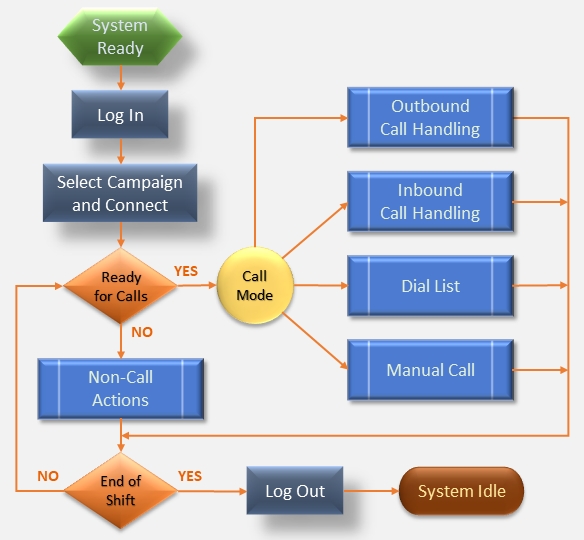
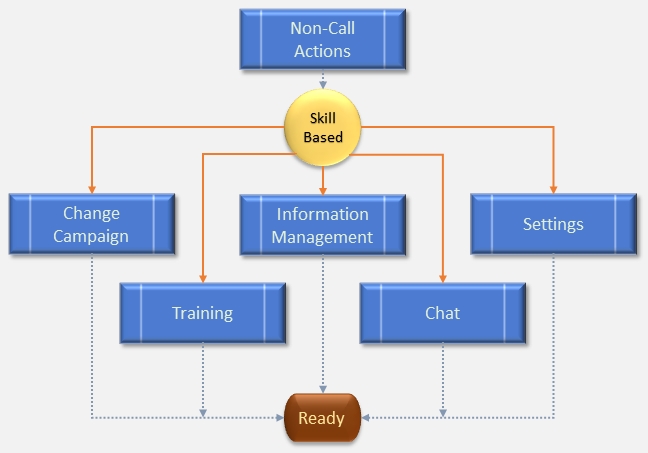
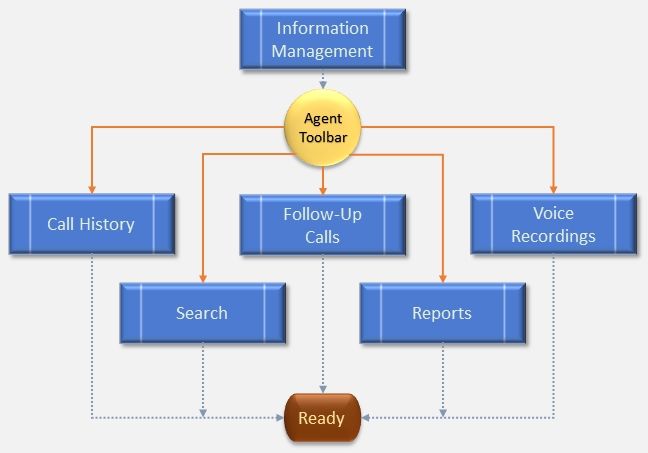
The DialedIn CCaaS Agent Client application (formerly ChaseData) is the all‑inclusive interface for all Call Center agent activity. It is a clean, easy‑to‑use, but feature‑packed client application, which allows every agent to perform the assigned activities, providing all the required information and tools, as assigned by a Manager or Administrator through the Management Console (as discussed in a previous section).
Call handling is the main and most important activity supported by the DialedIn CCaaS Agent Client application, but it’s certainly much more than a simple call handling activity, as the Agent Client supports the complete process of a Call Center’s Outbound Call Management and Inbound Call Center, with a myriad of tools around it.
We’ll discuss topics around the following domains:
Do keep in mind that what is available to a particular agent will depend on login, permissions, and assigned data and components, as performed by a Manager or Administrator.
Now, DialedIn offers two versions of the agent app; the newer Agent Web App and the legacy one. They both provide similar capabilities, so it's mostly a matter of what fits your situation. Below, we discuss both.
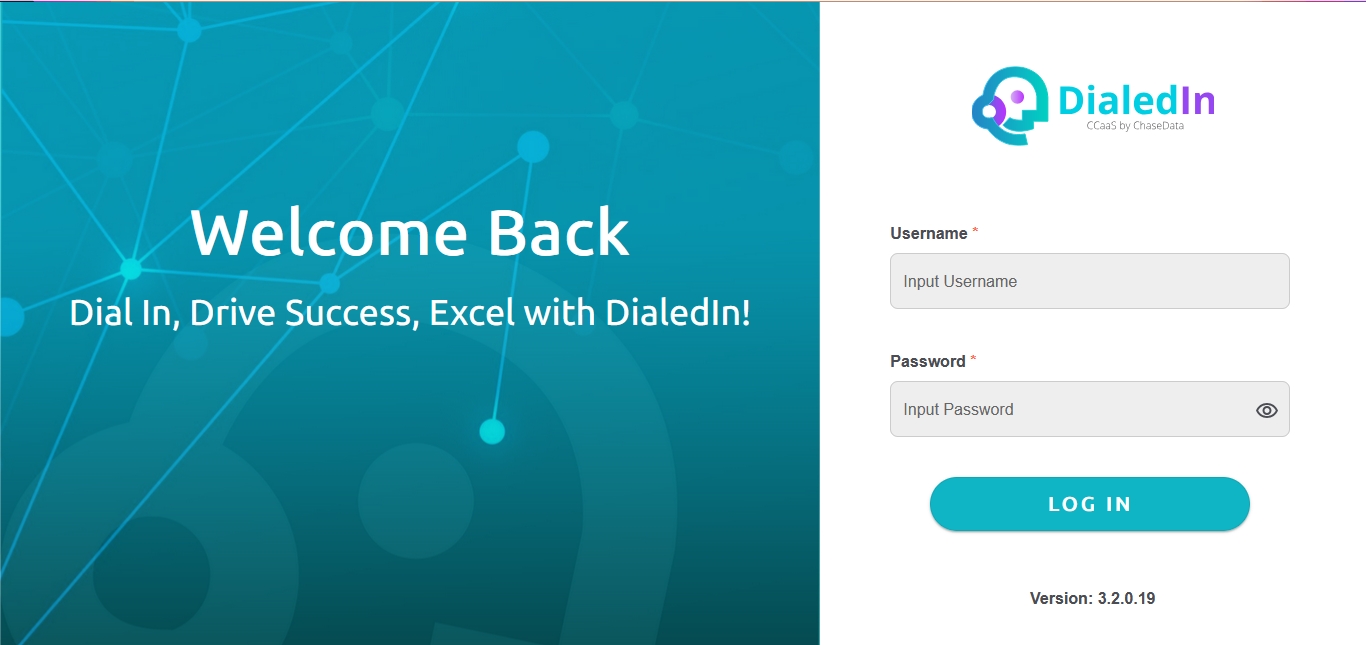
DialedIn's Agent's web interface is the sleek interface of choice used by call center agents. It is easily accessed from a browser through a URL specific to your operations. From there, the agent just needs the proper credentials to sign in and be ready to conduct corresponding call center activities. Refer to the following picture.
The agent interface is intuitive and easy to navigate, providing the tools to make your agents effective. The top bar includes application links and agent panel access. Then you have the main menu bar on the left for key actions, and the agent workspace is used to display all kinds of information relevant to each particular activity, calls scripts, and much more. Refer to the following picture.
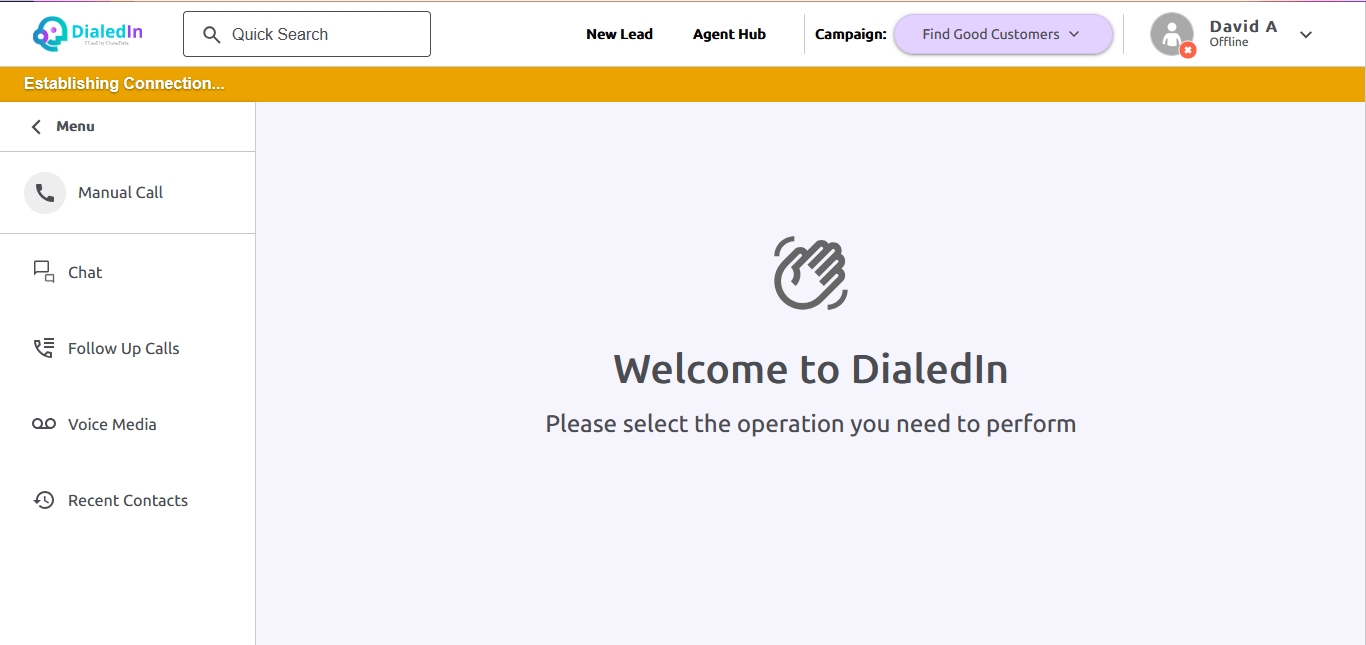
By expanding the agent panel the agent can change his/her status; for example Available for calls, a Busy status, or Offline. Can also modify agent profile. Then adjust a number of application settings, whether it's sound levels and effects, icon sizes, dial pad behavior, and notifications.
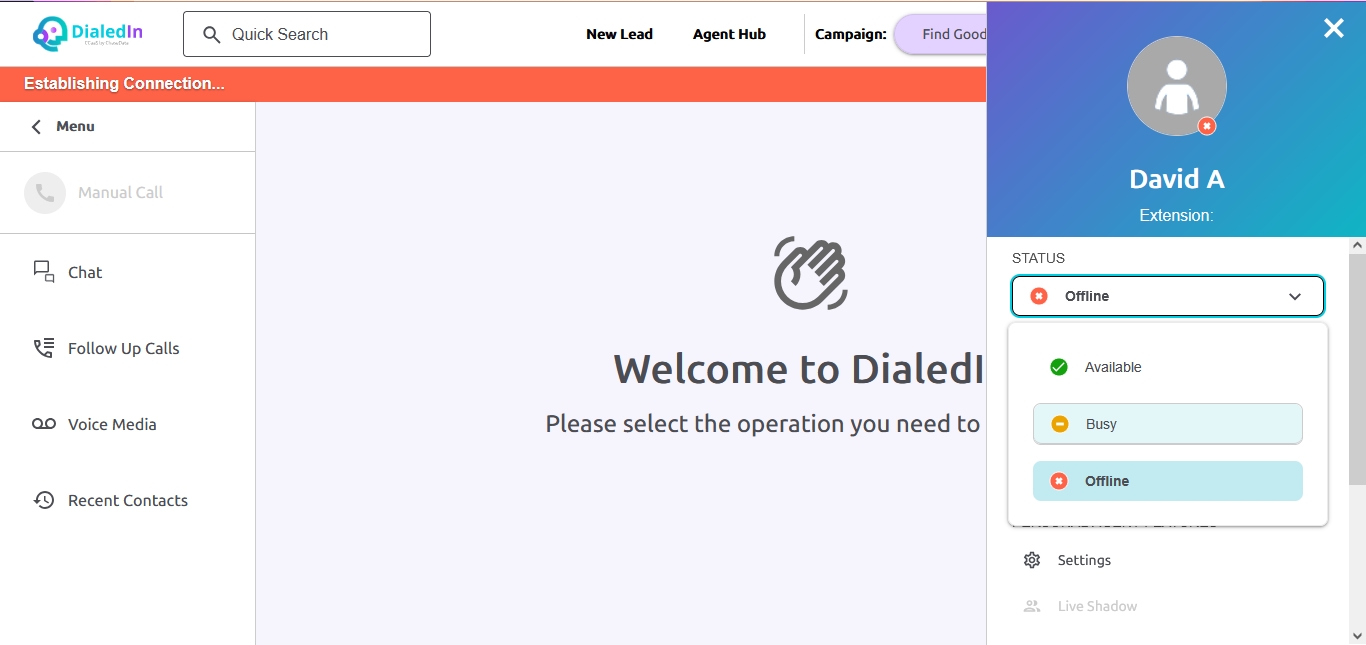
By expanding the agent panel the agent can change his/her status; for example Available for calls, a Busy status, or Offline. Can also modify agent profile. Then adjust a number of application settings, whether it's sound levels and effects, icon sizes, dial pad behavior, and notifications. The agent panel also gives access to a switch to toggle between normal and dark modes, among other things. Refer to the following pictures.
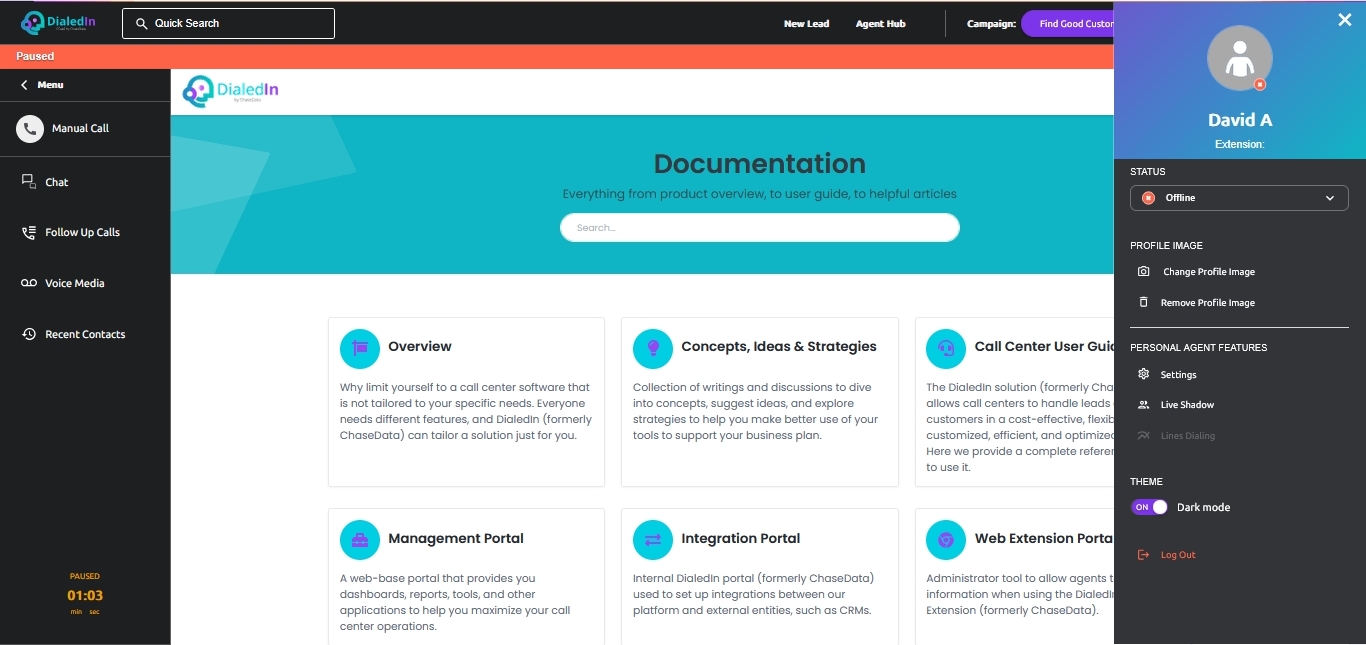
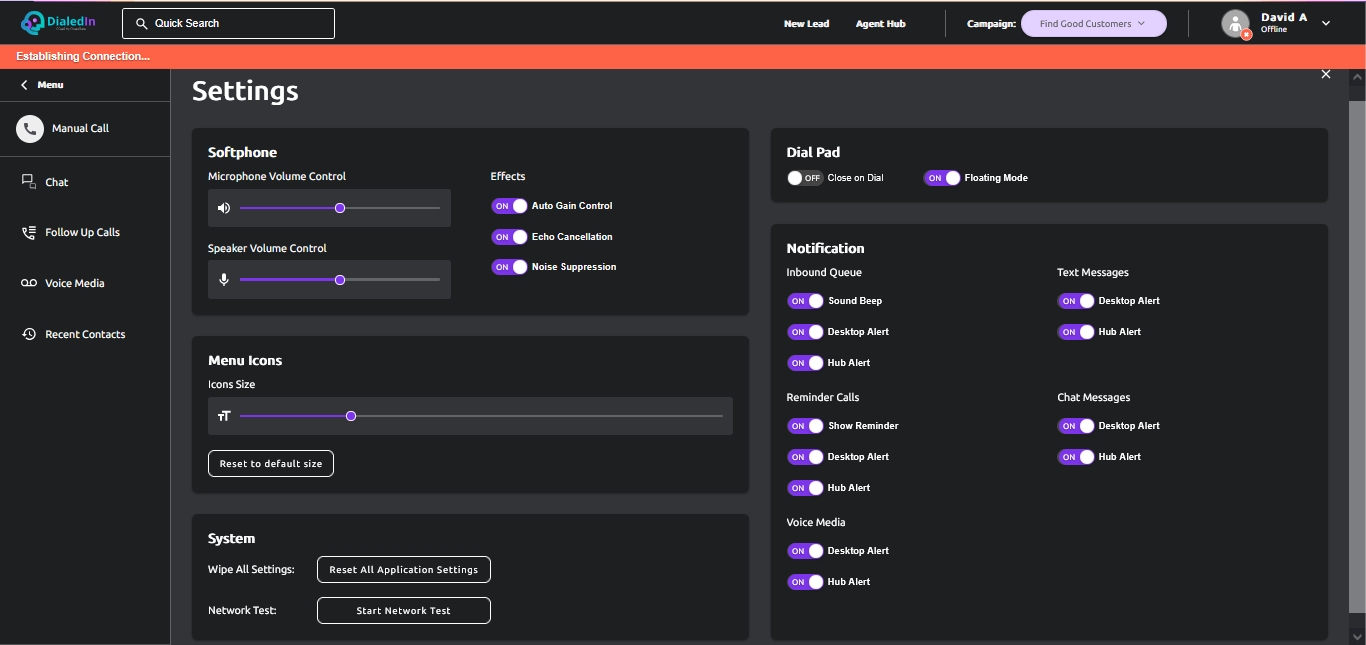
Other things you can do from the top bar is to change your campaign, look at the agent hub, to check things like voicemails and notifications, and to create a new lead, if allowed. Refer to the following pictures.
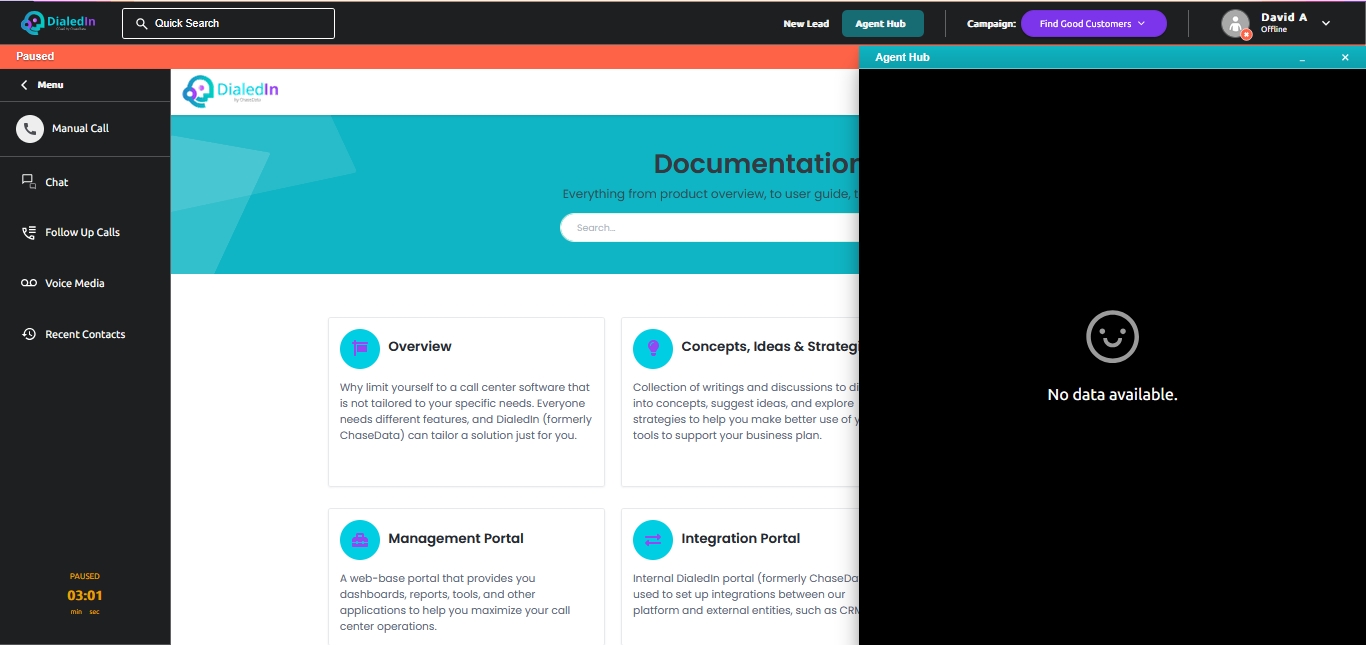
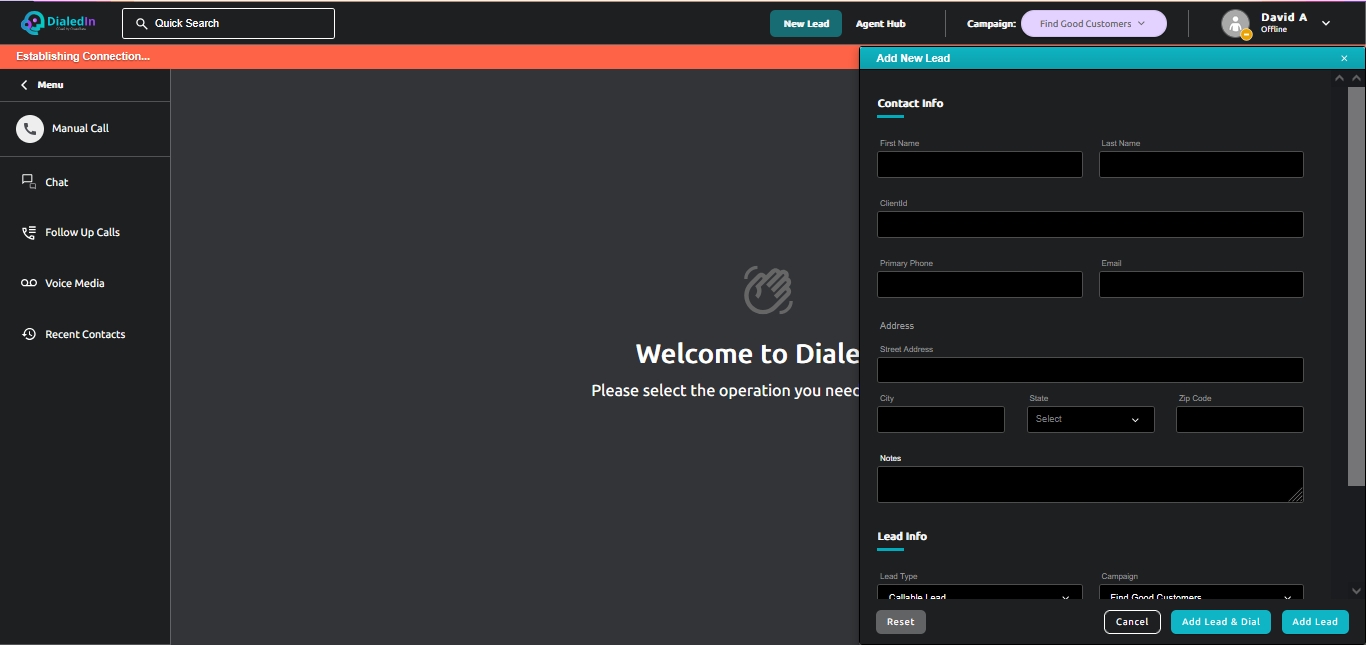
During a call, the phone dial pad opens up, which the agent can reposition at will. And whether it's a manual or queue initiated call, the call screens configured for the particular campaign and action are brought up in the agent workspace; in this case, we have the contact information card on the left, and call scripting on the right. The contact information card allows the agent to make changes, as well as to flip it to review contact history, which includes access to recordings, transcripts, and AI-based analysis. When hanging up a call, it requires the agent to disposition it before being able to continue to the next call.
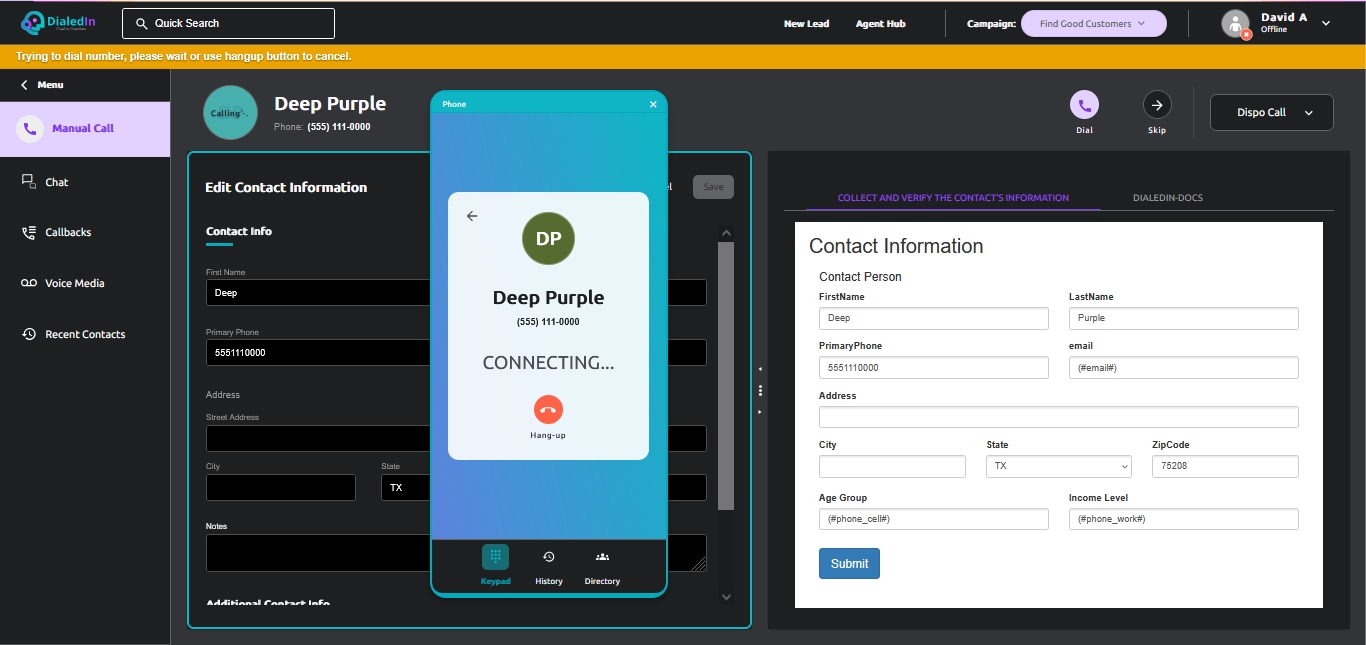
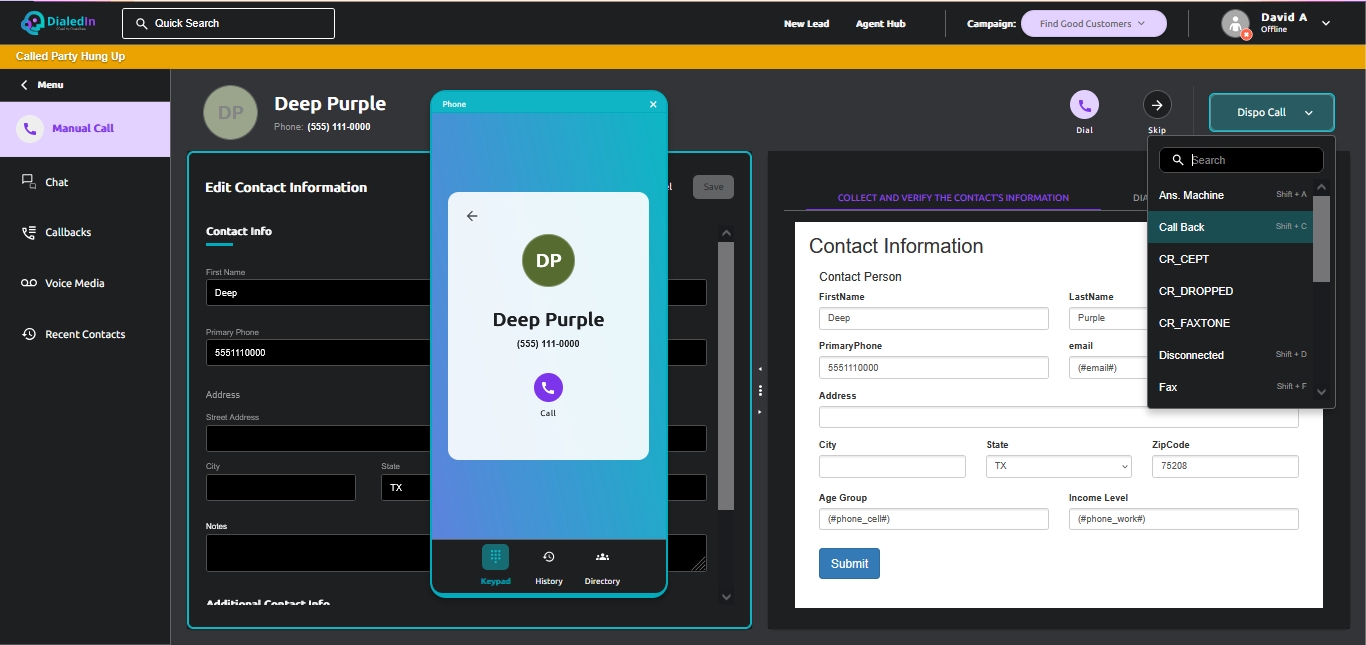
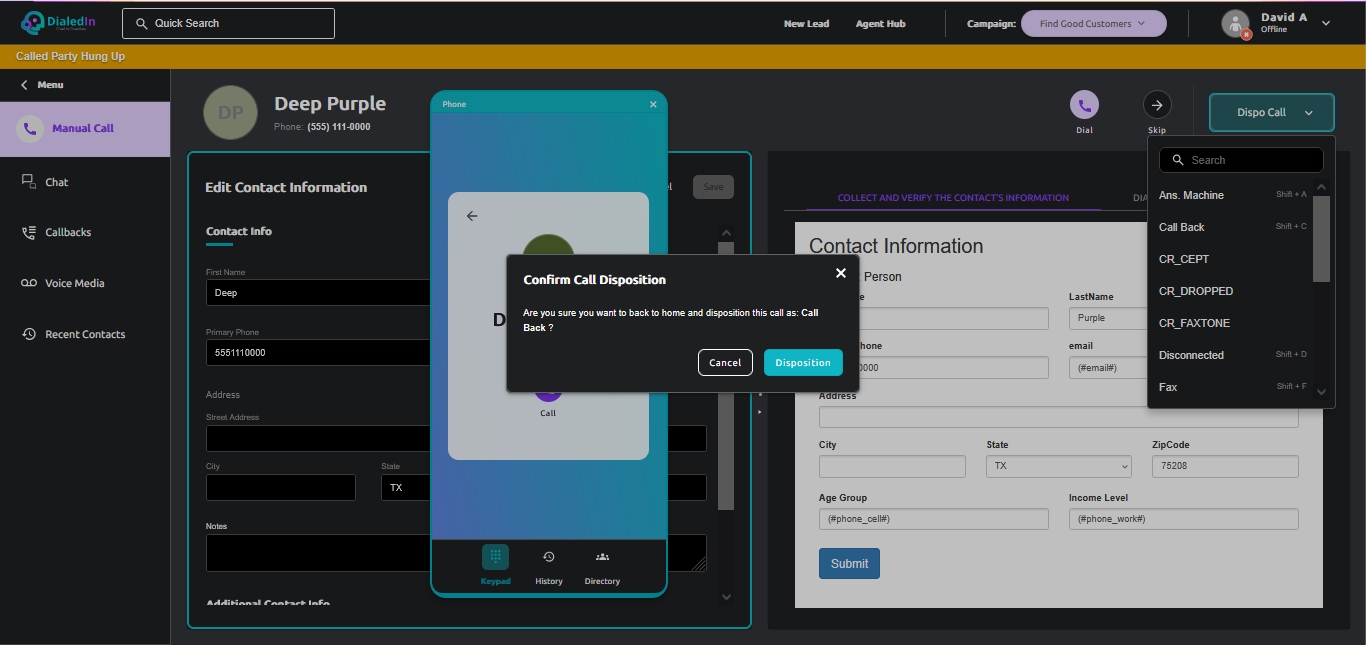
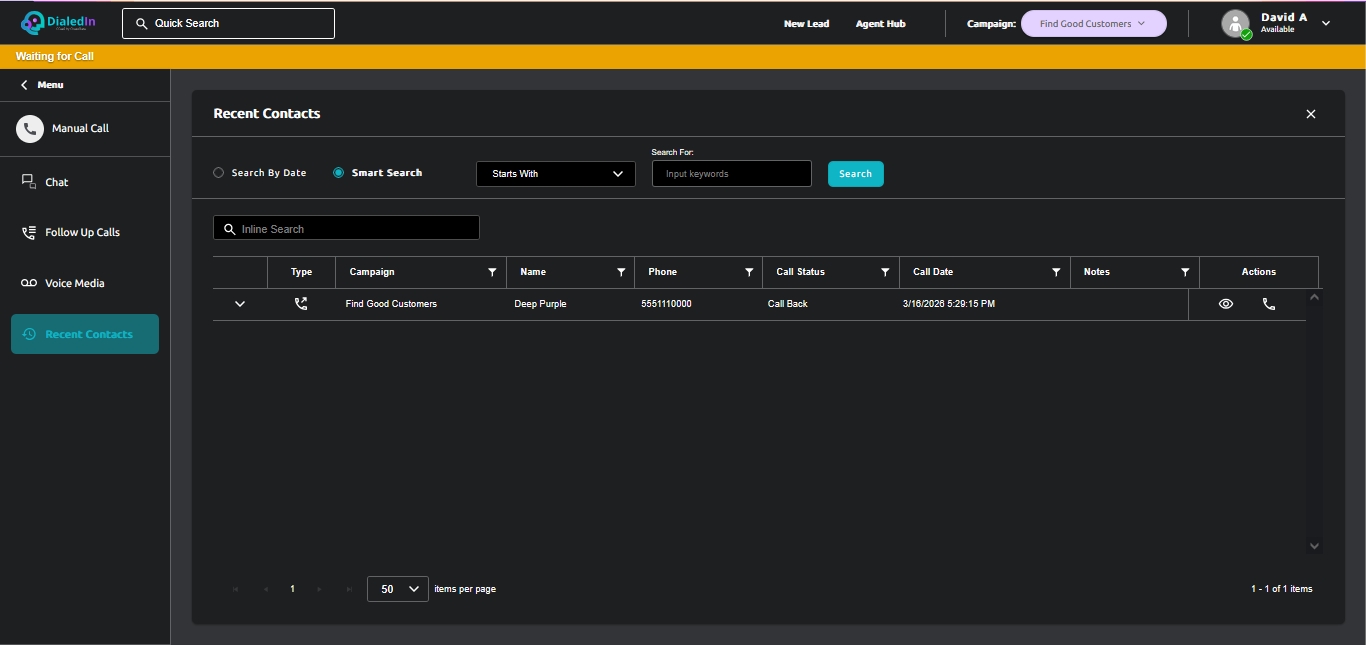
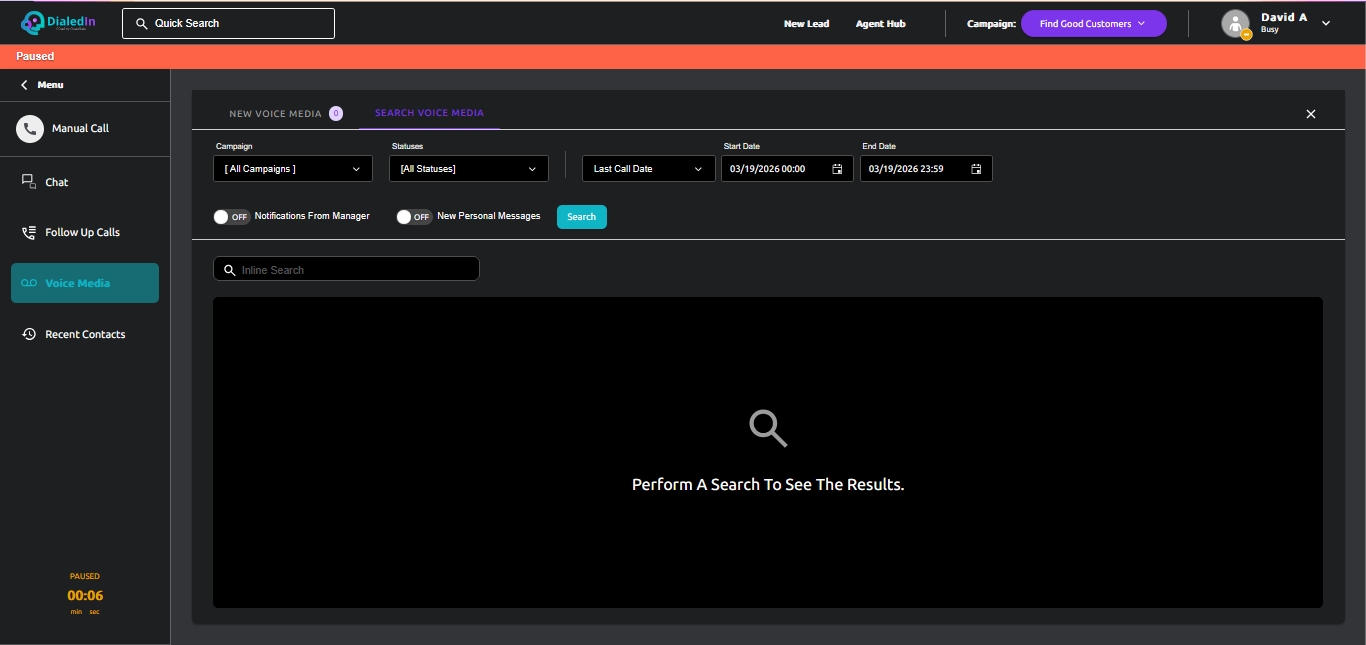
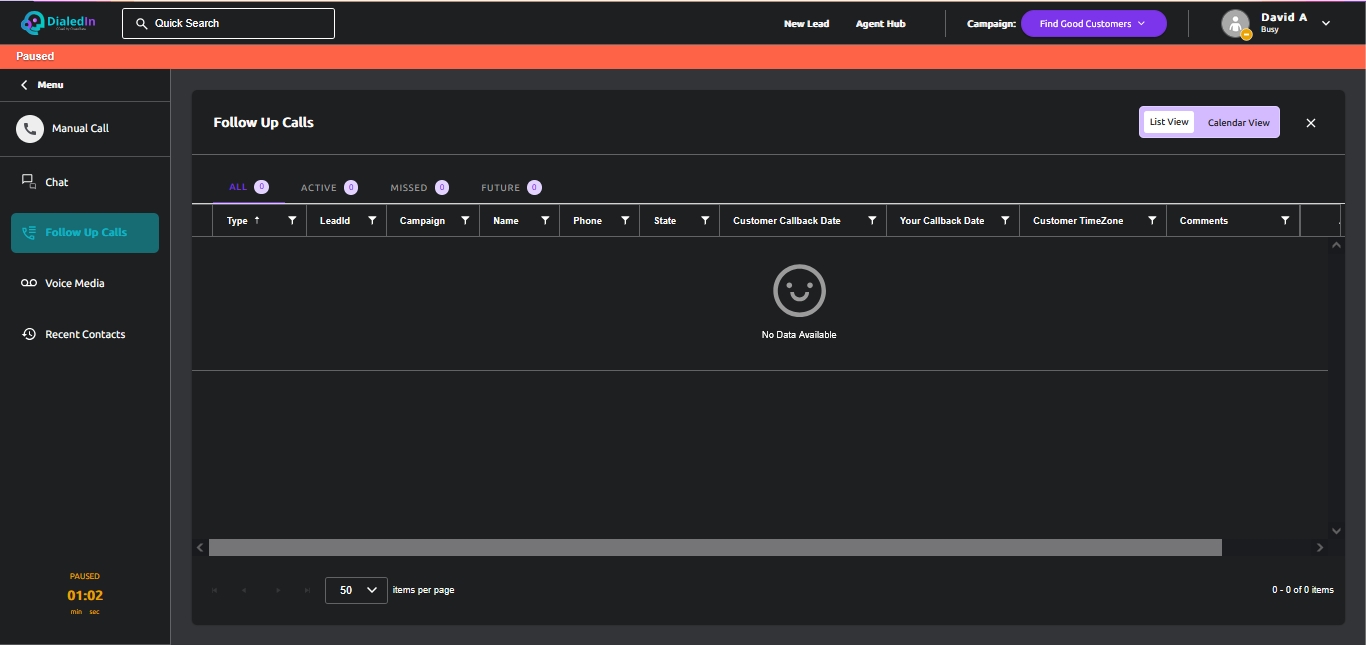
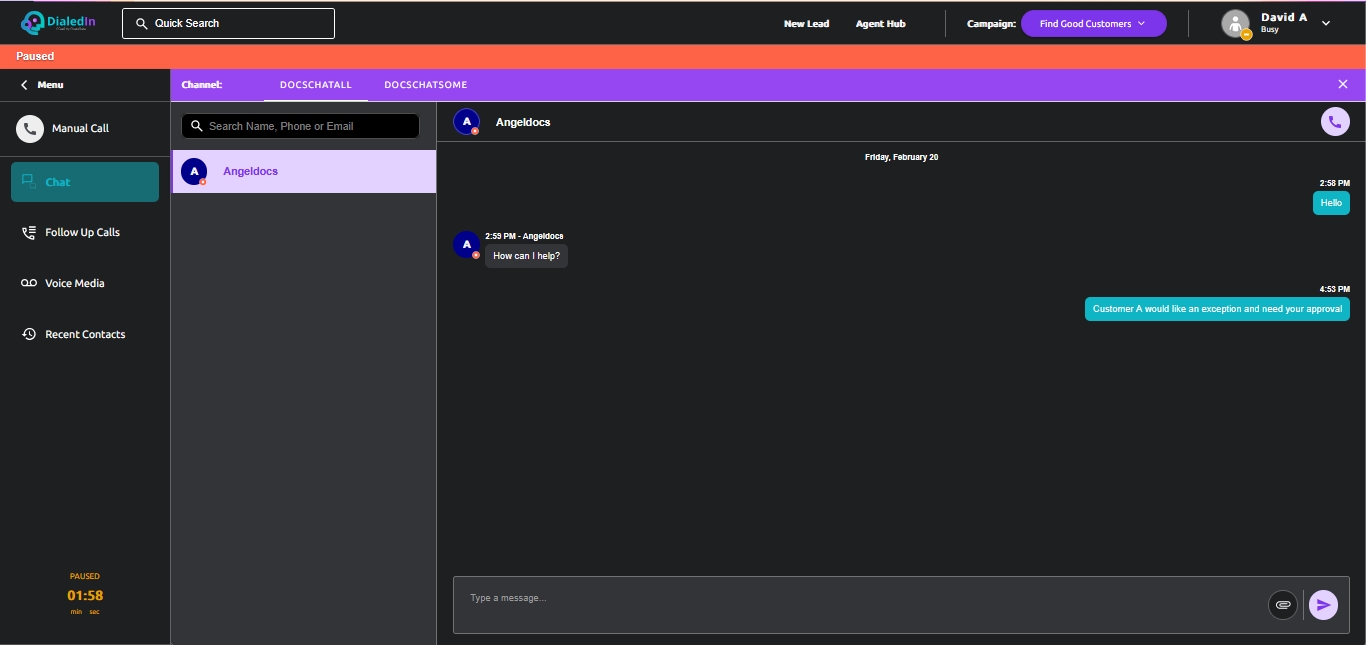
A number at actions are made available on the left menu bar; some standard, some added for particular setups. For example, an agent can send and receive SMS to and from customers, can chat with other agents configured to do so and logged in, and work on follow up calls. The agent can review recent voice media such as voice call recordings, listen to them, and check supervisor ratings applied. Can also search for other recordings, adding notes, and more. And the agent can look at a list of contacts that the agent has called during the specified date range. Refer to the following pictures.
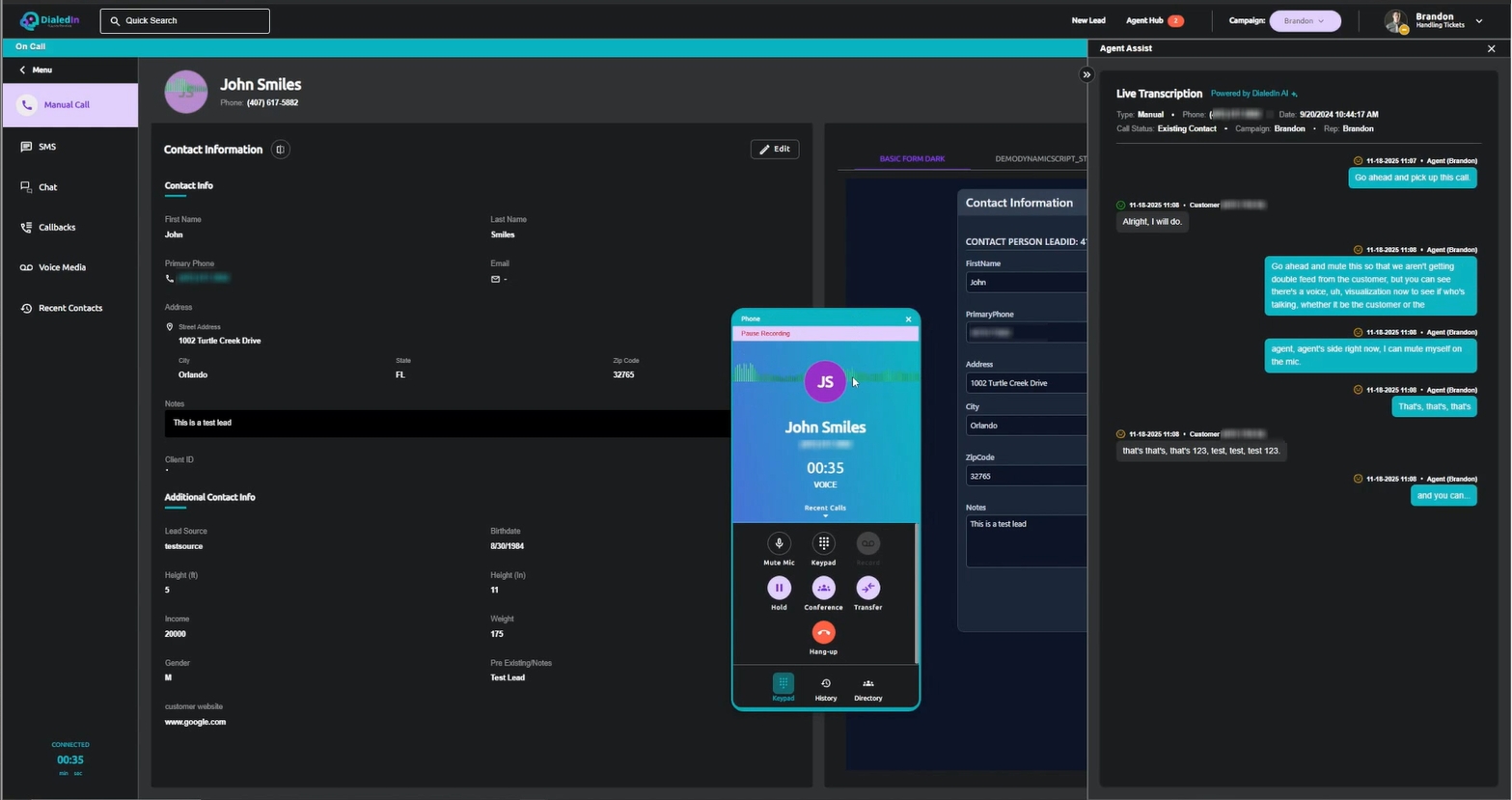
During a call, the scripting area is populated with the scripts assigned for the relevant campaign, like, for example, the contact's information. Contact and call information is displayed on the Agent Assist window panel, as well as a live transcription of the call.
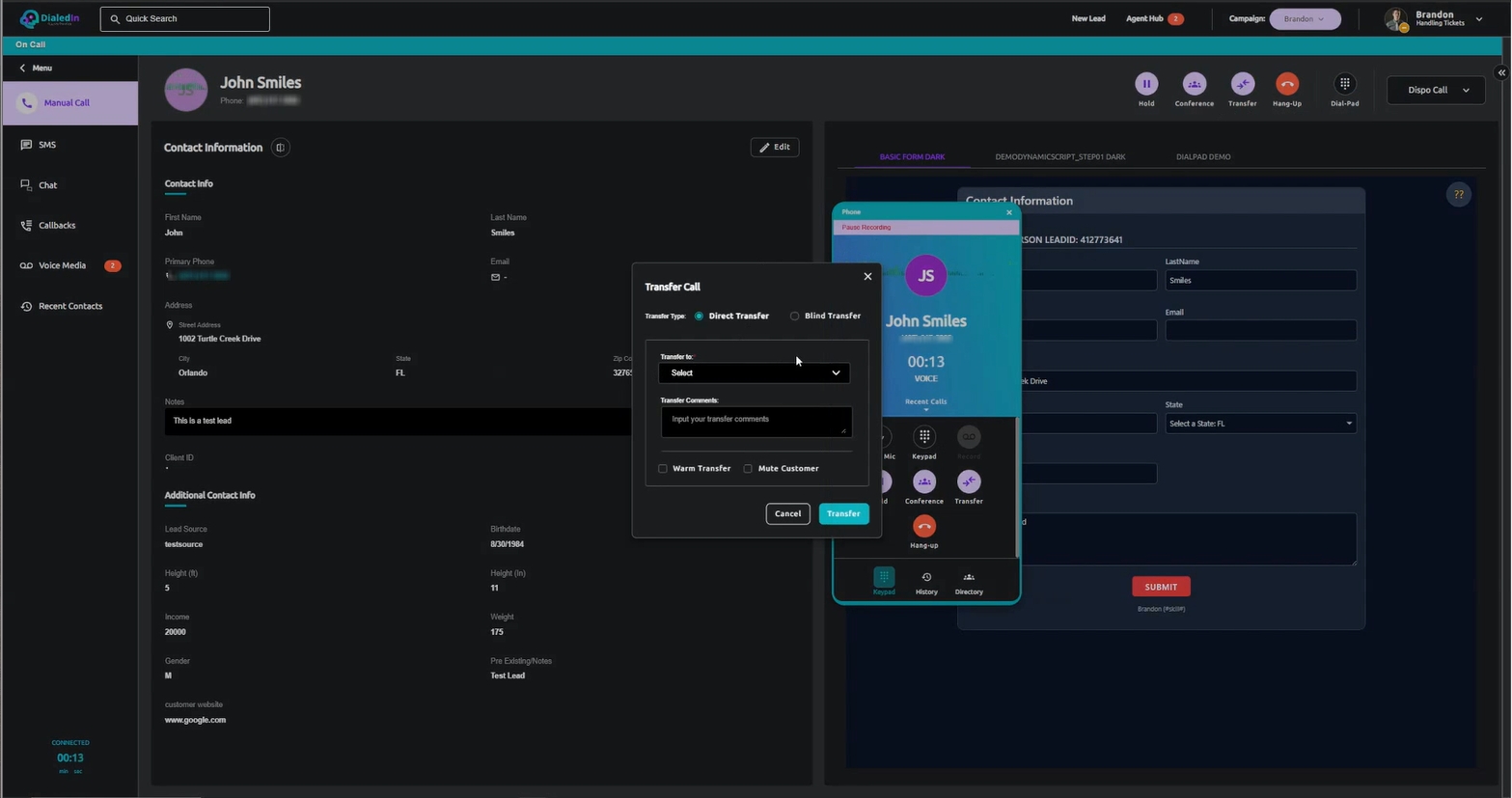
The dial pad includes buttons to place the call on Hold, Conference the call, and Transfer the call, among other things, each with its own sequence of follow up events possible, usually in the Agent Hub panel. Notice that some of those actions can also be performed from the workspace. Refer to the following picture.
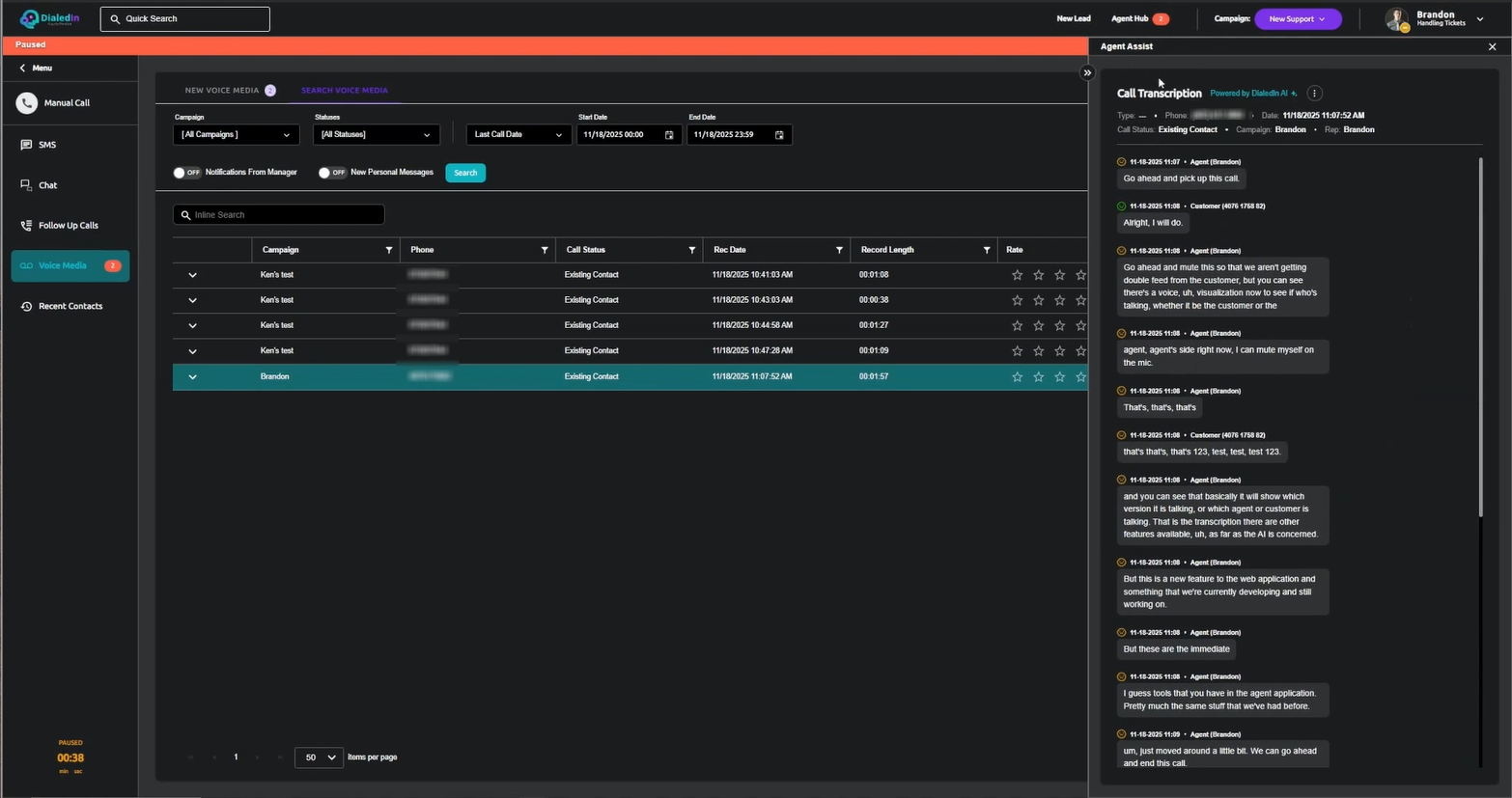
DialedIn provides a number of very useful AI-supported capabilities for analyzing calls, which can be accessed through Voice Media. The agent can start by looking at the call Transcription.
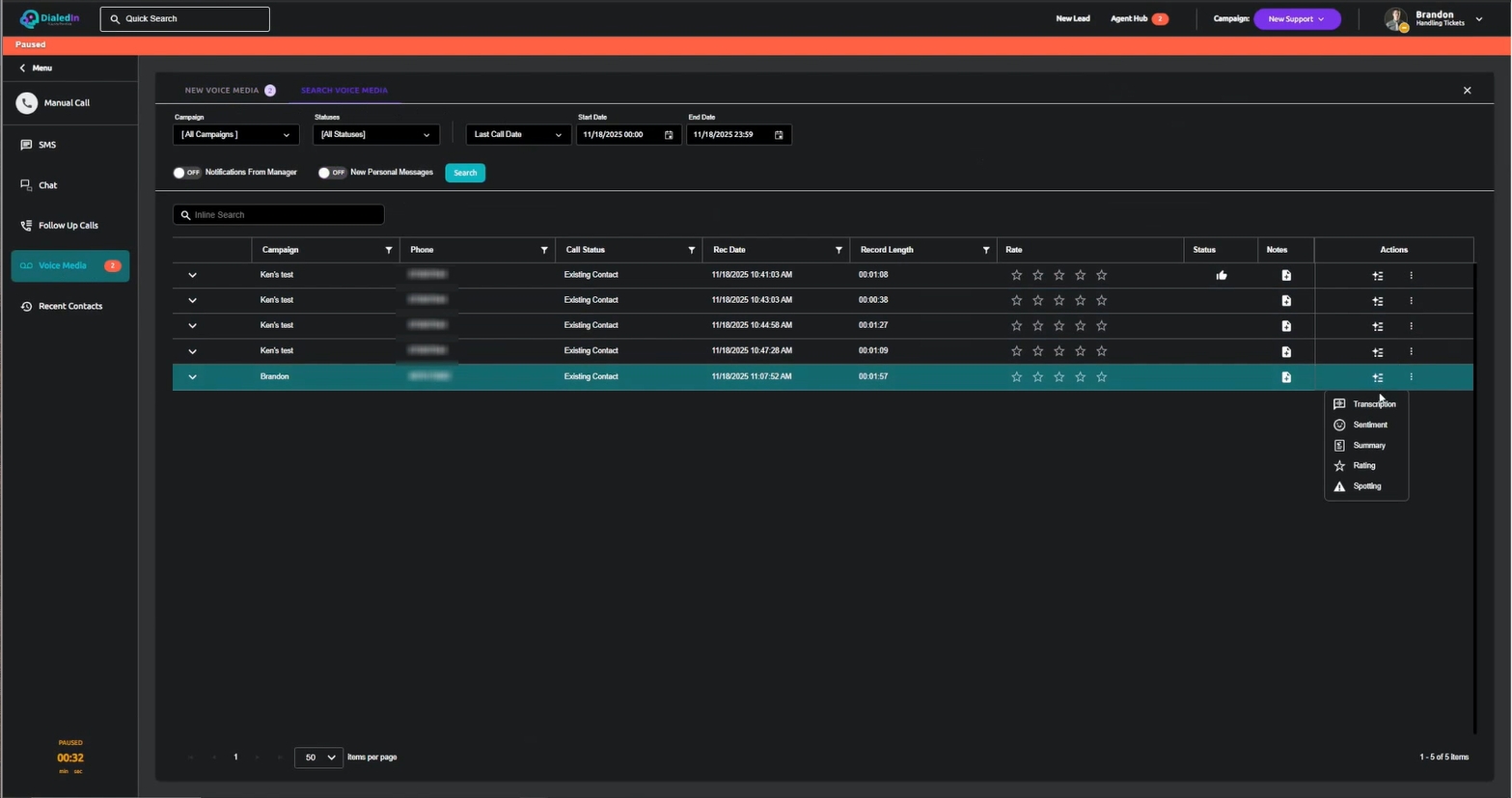
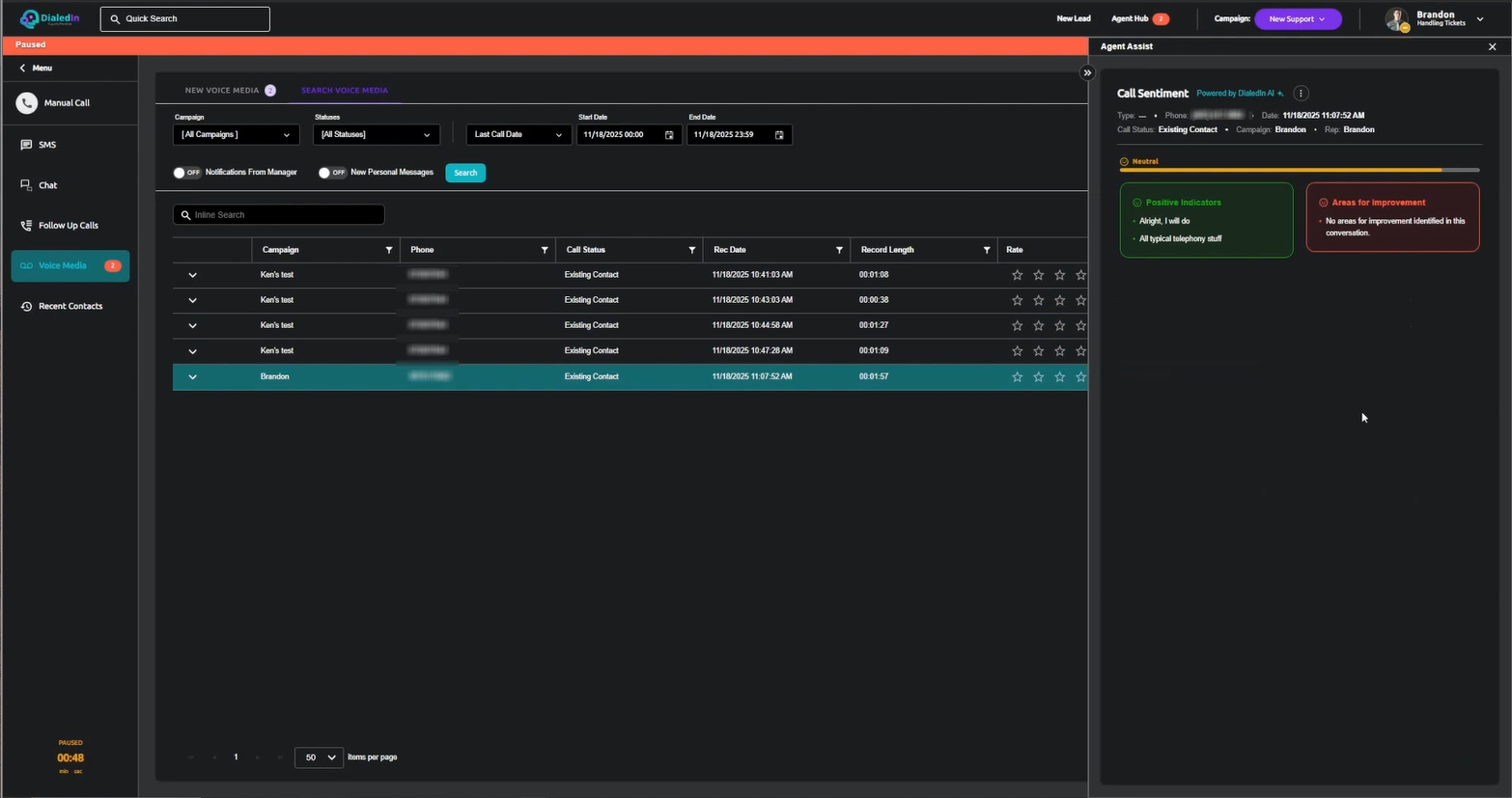
Then get the AI-generated Sentiment analysis of the call, which provides overall positive indicators of the call, as well as suggested areas of improvement.
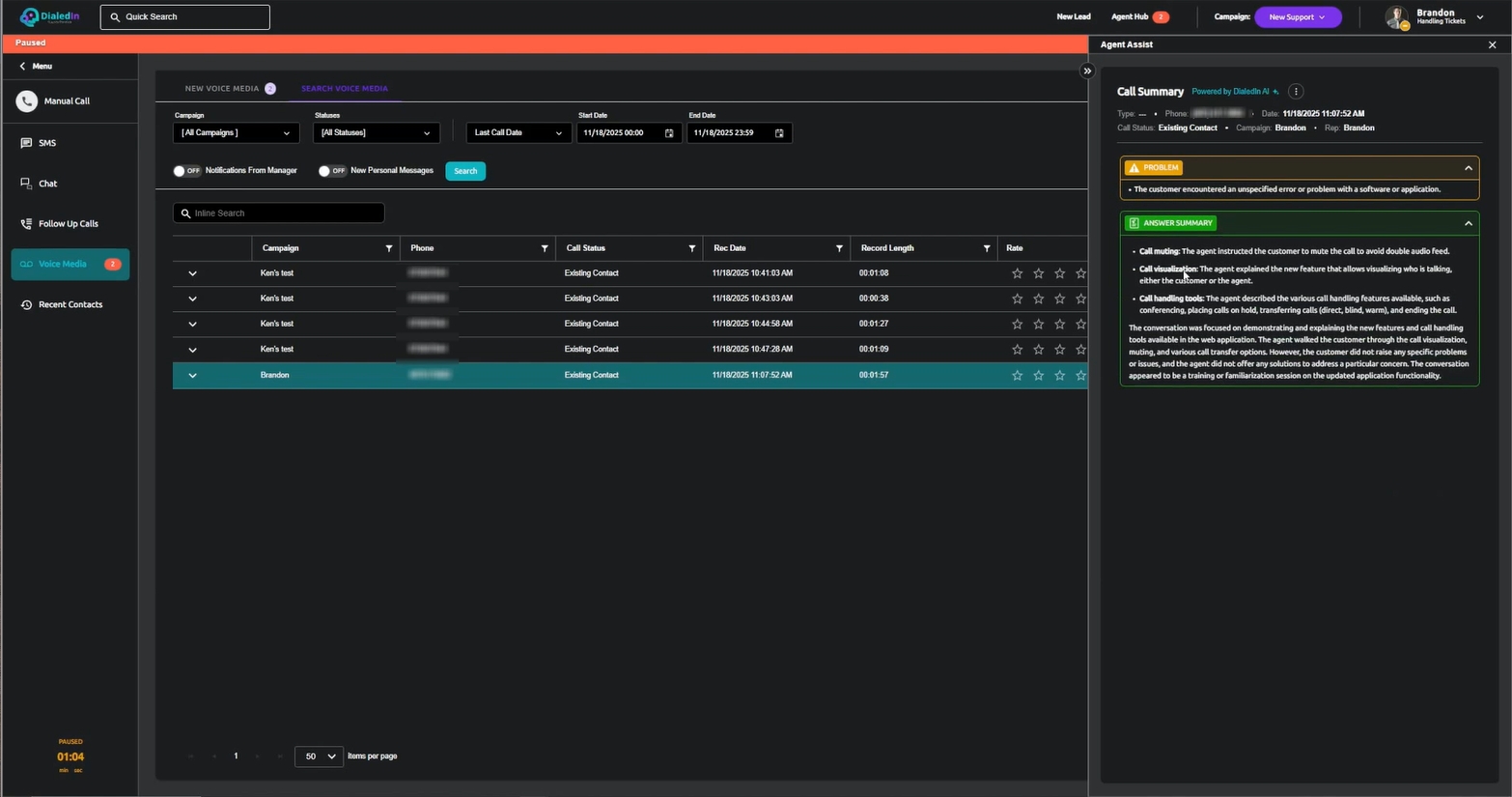
Next, the agent can get an AI-generated Summary of the call, split into PROBLEM, which is basically the subject of the conversation, and ANSWER SUMMARY, which describes the content of the conversation.
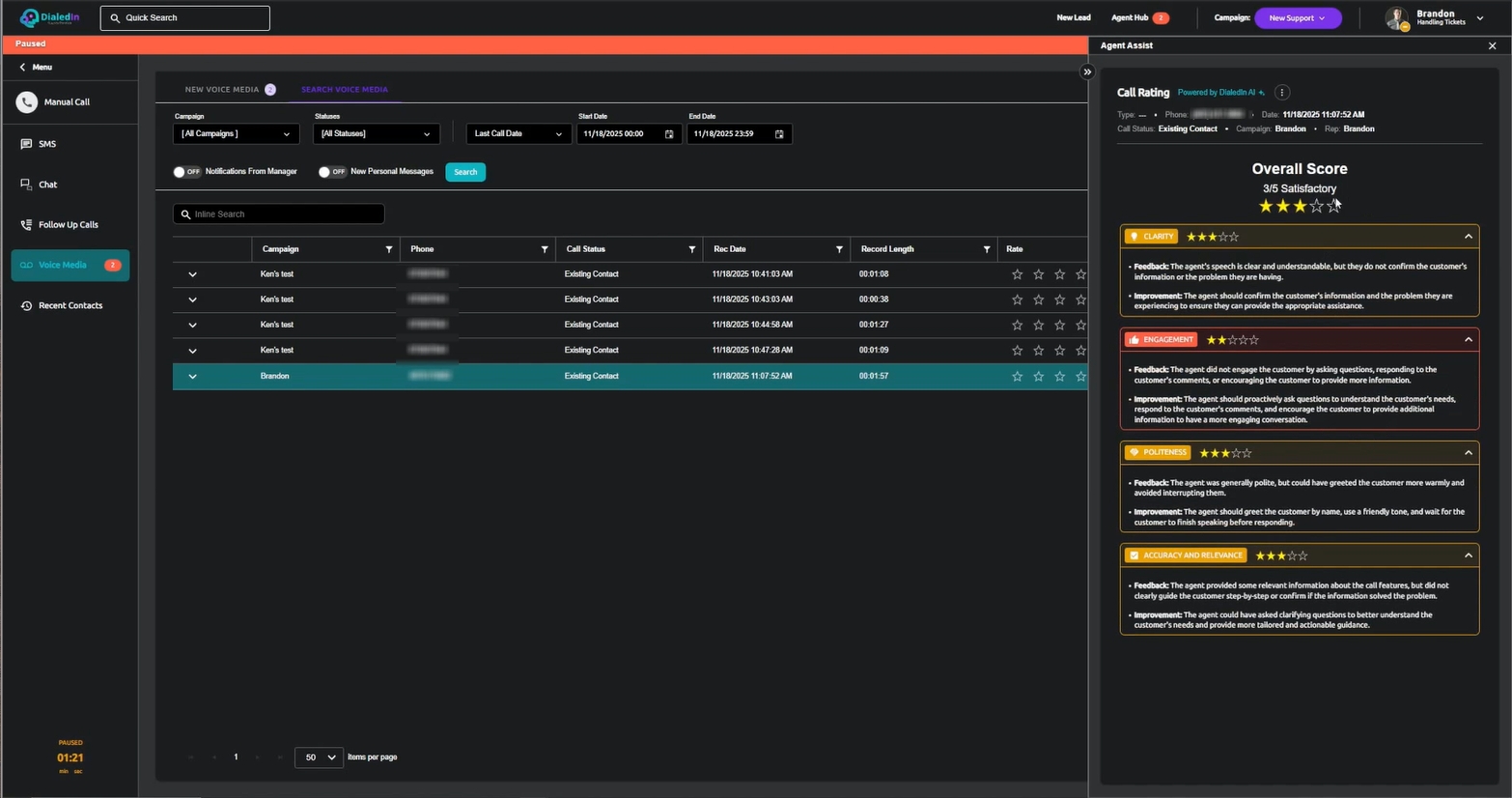
Rating generates a score based on four aspects of the call: clarity, engagement, politeness, and accuracy & relevance. It includes feedback and improvement suggestions for each of those areas.
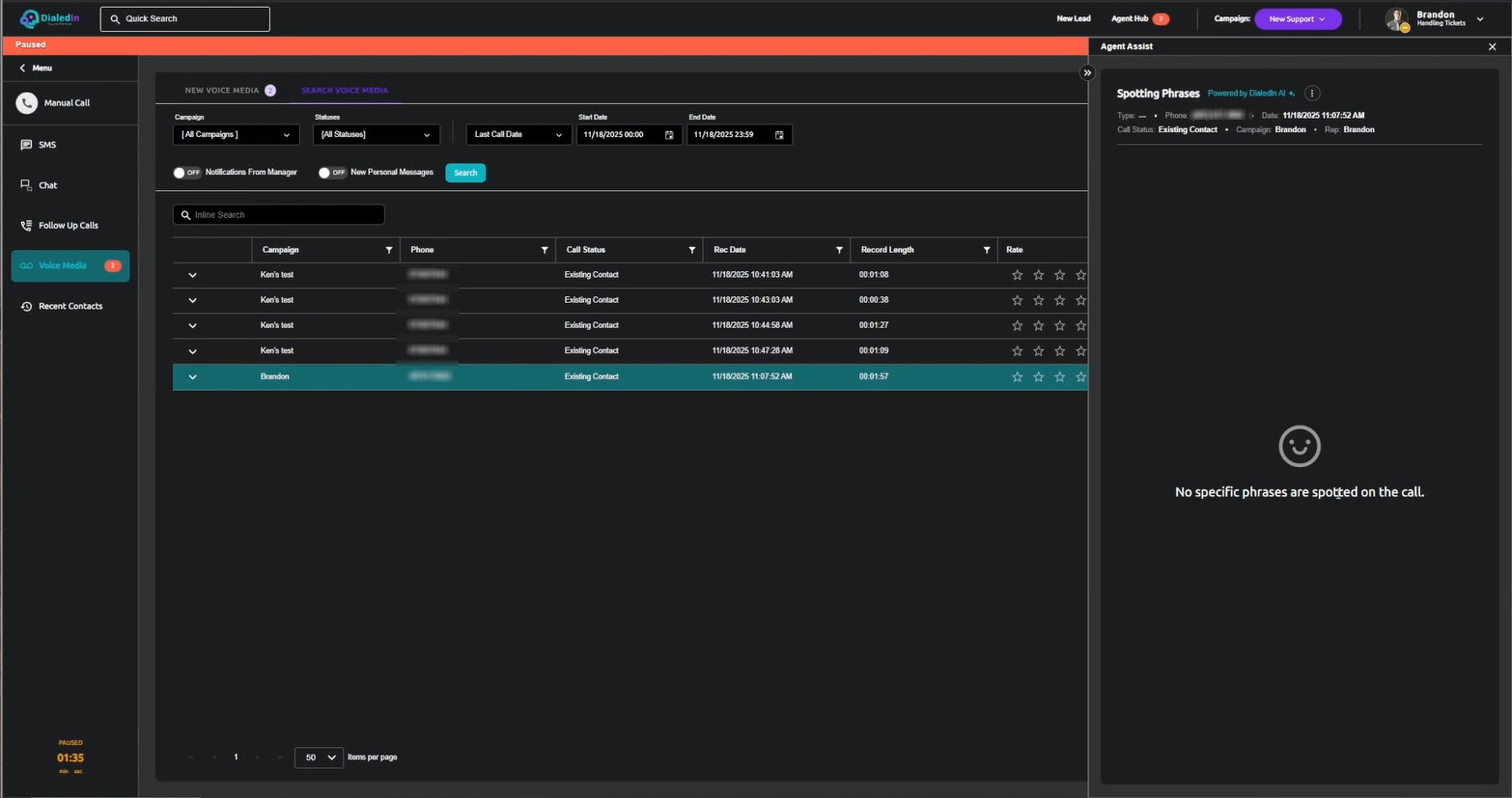
And Spotting analyses the call for phrases that may need special consideration, like "do not call me anymore" and things like that.
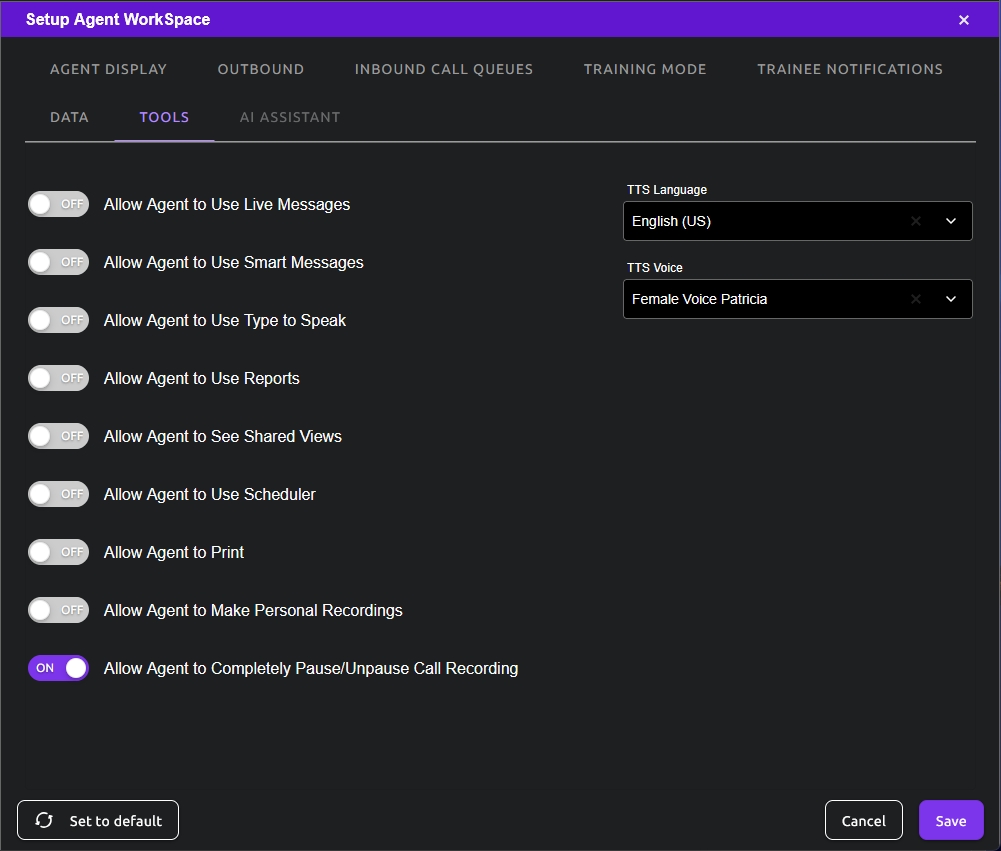
An agent's skill could be enabled to allow the agent to manually pause the recording of a call, as well as resume recording. There could be many reasons to allow for this behavior, usually to align with a regulatory requirement, or to protect sensitive information, for example. This is on the call center's discretion.
As it was mentioned, first and foremost, the agent has to be allowed to do this, which is done through a setting for the relevant Skill. Refer to the Skill Tool Options tab in Agent Skills. Make sure that the option to Allow Agent to Completely Pause/Unpause Call Recording is enabled.
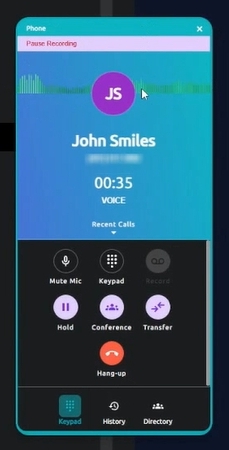
Now, during a call the agent is shown the option to pause the call at the top of the dialpad. The option changes to unpause afterwards, so recording can be resumed when needed.
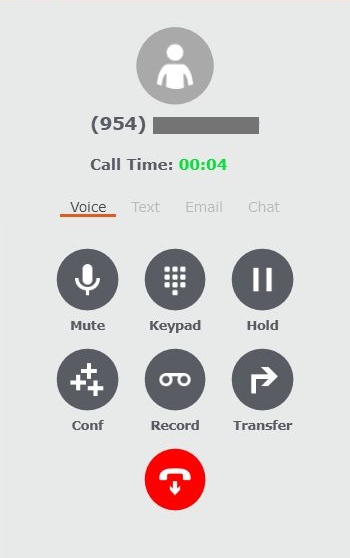
For the legacy DialedIn agent app, please refer to relevant ChaseData documentation HERE.
For installation of the legacy DialedIn agent app, please refer to relevant ChaseData documentation HERE.
For an overview of the legacy DialedIn agent app GUI, please refer to relevant ChaseData documentation HERE, including the Dialpad, the Agent Hub, and Personalized Layout and Settings.
For understanding how the legacy DialedIn agent app handles calls, please refer to relevant ChaseData documentation HERE, including about Outgoing Calls, Incoming Calls, Conference Calls, Call Transfers, and Changing Campaigns.
The ability to transfer calls is essential for advanced call centers, and DialedIn provides the ability to do so, whatever your need or business process requires, like, for example, when a screening process is completed and it’s time to move on to another agent or department. DialedIn allows performing a Direct Transfer, which can be a Cold Transfer or a Warm Transfer, or performing a Blind Transfer. Any of this can be done while on a call.
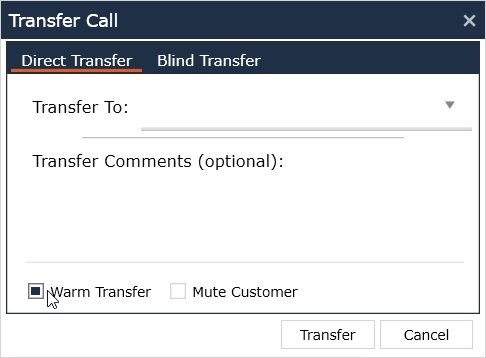
During a call, click on the Transfer icon (e.g., on the Dial Pad) to pop up the Transfer Call window, where we can select from a list of allowed Agents (based on the current Campaign) and specify the transfer method. Refer to the following pictures.

There are two ways to transfer a call to another agent:
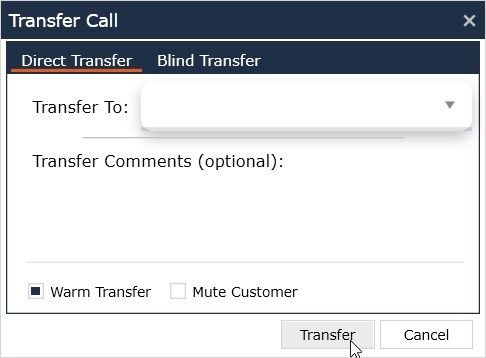
In both cases, Transfer To presents a pull-down menu of available nunmbers for the transfer, and Transfer Comments gives you the options to indicate any relevant information about the transfer.
With a Direct Transfer the intended recipient of the call transfer is made aware of it; for that agent, a message pops up indicating who has initiated the transfer request, the related Campaign, and any comments provided by the requestor. The agent receiving the transfer request has the option to accept or decline the transfer.
By default, a Direct Transfer is a Cold Transfer, in which the agent requesting the transfer (fronter) drops from the call when the transfer is accepted. If the Warm Transfer option is selected, the fronter stays in the call, with the option to drop at any time.
A Direct Transfer also has the option to Mute Customer so the fronter and the closer (transfer recipient) can talk to each other privately until the customer is unmuted.
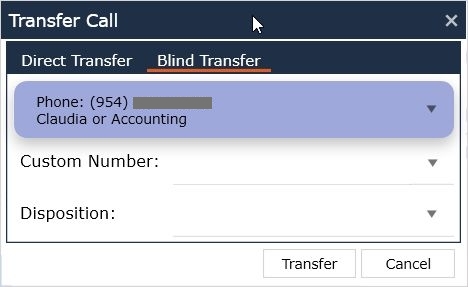
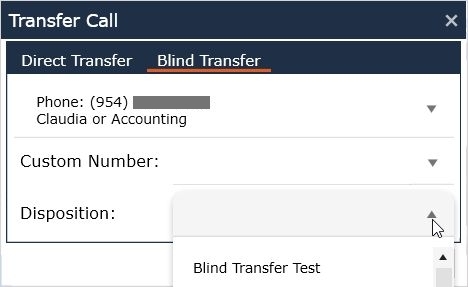
A Blind Transfer just sends the call to the Transfer To agent, without any interaction. The agent making the transfer (fronter) sets a Disposition for the side of the call that ends with the transfer.
In this case, in addition to a list of available Transfer To agents, the agent making the transfer can optionally just enter a Custom Number to direct the transfer to.
To see how the legacy DialedIn agent app makes data and information available to the agent, please refer to relevant ChaseData documentation HERE, including Call History, Recordings and Voicemail, Search, and Reports.
To see the tools offered by the legacy DialedIn agent app to the agent, please refer to relevant ChaseData documentation HERE, including Chat and Network Test.